Category Archives: The Chaperone of Death

Invalidators and Saboteurs

Like every other world, the classical music world is populated with predators who will do their best to invalidate your accomplishments and/or sabotage your position. I met quite a few predators during my long career, and many of them have either threatened me or threatened other people with their lies and innuendos.

One particularly egregious case of threating behavior involved our concertmaster, Dennis Cleveland, an outstanding violinist who had been the first violinist of the Audubon String Quartet for many years. During his first year as concertmaster, his assistant complained that Dennis played out of tune. Because of this complaint our conductor, Kenneth Schermerhorn, was ready to fire him. As the chairman of the orchestra committee it was my job to get involved in situations like these. My reaction to this was to back Schermerhorn into a corner and say, “Dennis has come into a job where he has to play four concertos (Prokofiev No. 1, Chausson Poeme, Mozart Sinfonia Concertante, and Bach D Minor Partita) ten stand-up solos (lasting five minutes or so), and a repertoire of fifty ballets. Under these circumstances, during a season of twelve service weeks, who would be able to play perfectly in tune on all of it?” I suggested that, at the very least, Dennis should be given another year before such a decision would be made.

Maestro Schermerhorn left the orchestra two years later, and Dennis’s assistant made the same complaints as before to the new conductor. I was called in to consult about this matter. I refuted all of the assistant’s charges, insisting that Dennis was an outstanding violinist and concertmaster, and that ABT was lucky to have him. I also added gratuitously that his would-be assassin would probably crash and burn in three weeks, given the pressures of the job. The new conductor finally asked me if I knew that Dennis complained that I played out of tune, and I responded by saying, “If Dennis said I played out of tune, there can be no doubt about it.” The conductor gave up. A few days later the assistant concertmaster accosted me, asking how I could do such a thing.  My reply was that as a principal player who has also dealt with ambitious assistants, who did you think I would back up?  Dennis was given tenure, and remained one of the outstanding concertmasters of the American Ballet Theatre for ten more years, until his death from AIDS.

Although I didn’t elaborate to this colleague about my own experiences with reptilian colleagues who tried to discredit me, unhinge me, or get me fired. I had a lot of experience with people trying to tell me what I could and couldn’t do.

Sight reading has always been a problem for me because I have dyslexia. Needless to say, the sight-reading situations I found myself in when I was a Juilliard were embarrassing. I explained my problem with sight reading to my teacher, Luigi Silva, and he told me that if I couldn’t sight read, I shouldn’t entertain any hopes of becoming a professional musician.

I knew early on that sight reading was an impossibility for me, but I knew how to read music well, and had an excellent memory. I could play music that I already knew very well, and was able to avoid situations where I could be a caught off guard, and learned and memorized all the music that I played. Contrary to Luigi Silva’s prediction, I had a perfectly fine career.

Catell Calls

During a 17-week tour of the Royal Ballet, I was assistant principal to Albert Catell, who had studied with Emanuel Feuermann. Catell was a very fine cellist who always made it clear to me how much better he could play the big cello solos from Swan Lake, Sleeping Beauty, and Giselle than I had any hope of equaling. It was only a few years later that I played all of these big solos on national television, and even received compliments on some of them from Leonard Rose.

One day, while I was at Dov Buk’s violin shop, Albert Catell walked in. He took a look at my cello and asked what it was. I told him that it was a Guadagnini. He told me that it didn’t look like a Guadagnini, to which I replied, “Depends on who’s looking. Albert had a distinguished career, and I still admire his playing, but he never got out on a New York stage and demonstrated his prowess as a soloist. In that regard, I would have to say that I did follow the words of Winston Churchill when he said, “Success is not final. Failure is not fatal. It is the courage to continue that counts.” Perhaps at the beginning of my career, I didn’t feel like I had too much to lose by presenting recitals in New York and finding out whether or not my expectations would be met.

Mosa Havivi, a friend of Albert Catell who also had studied with Feuermann, ran an instrument shop.  He was a fine cellist, but he had a strange attitude towards professional musicians. He told me that he didn’t want to prostitue himself by doing any professional work, and that he turned down the first chair of the Metropolitan Opera orchestra because he didn’t want to spend his life working on those “hard German operas.” I have no idea whether he was telling me the truth or not, but I know that I learned more about playing the cello from playing the operas of Wagner, Strauss, and Berg than I did from any of the standard etudes and concertos. I was always the loser in his many sharp deals, but he did end up saving me a lot of money when it came to buying expensive instruments and bows, because once I recognized that the only thing that I could know for sure was whether a cello looked good, sounded good, and fit my budget, I was able to do very well without being fast-talked by anyone.

My first assistant at the Lyric Opera was Joseph Saunders. He was about the same age as my mother and had spent twelve years playing in the Chicago Symphony with Fritz Reiner. Saunders had plenty to say about my orchestral inadequacies (calling me a “ninny” of a first cellist, behind my back). He would insidiously tell, five minutes before I was about to play a solo, how some important cellist had messed it up. I finally told him (after not messing up anything) that if he expected me to follow in the footsteps of those paragons of cellistic virtue and mess up, he could forget it.

I figured out how to artfully fake hard passages so that I would arrive at the end with considerable panache.  My artistry would usually get a smile out of conductors, even important ones like Christoph von Dohnanyi. Joe usually got behind in hard passages while trying to play all the notes as written, and conductors would often give him a look of severe rebuke. I learned from this experience to follow my instincts and not listen to people who purported to know the right way to deal with orchestral material. Even in my first year at the opera I knew that sounding good is always better than sounding bad.

I have found that invalidators come in two varieties: those who damn by faint praise, and those who insult you directly to your face.  I was introduced to the first variety in my first year at the Lyric Opera. Minna Miller, wife of Frank Miller, who was the principal cellist of the Chicago Symphony and played principal cello under both Arturo Toscanini and Georg Solti, came up to me after the first rehearsal of Tosca, which has a big cello solo, and told me that my cello had a beautiful tone. I thanked her, and said that her husband’s cello also had a beautiful tone.

Frank Miller actually did have a very beautiful tone, and was very well-known for it, but whenever I encountered him, he never seemed to remember who I was even though every other cellist in town knew that I was the principal cellist of the Chicago Lyric Opera. When the American Chamber Trio and the Chicago Symphony String Quartet played on the same series in Phoenix on consecutive days, we decided to stay an extra day in Phoenix to hear the Chicago Symphony String Quartet’s concert. I went up to the stage at the intermission to say hello to Frank Miller, and asked me what I was doing there, to which I replied, “I’m surprised you recognized me.”

I encountered an example of the second variety (insulting you to your face) at my Juilliard graduation recital, when a very disagreeable colleague came up to me and said, “It’s a pity that with all your technique, you can’t make any music.” I replied, “It’s a pity that without all my technique, you can’t make any music.”

I learned from these experiences that what other people could do or couldn’t do had absolutely nothing to do with what I could do. All their opinions evaporated the minute I started to play. Whatever you have to play, you put the bow on the string and deal with what comes out. Of course, as Leonard Rose pointed out to me, there are many things you can do to put the odds in your favor, and that is entirely up to you.

One of my idiosyncrasies was to take a few drops of Binaca, a concentrated minty substance, before playing any major solos. The smell of the mint reminded me to breathe very deeply and very slowly, the physiological opposite of what would naturally happen in a nervous situation. This habit was tolerated by good grace, or even enjoyed by my colleagues who would say “I smell a cello solo coming.”

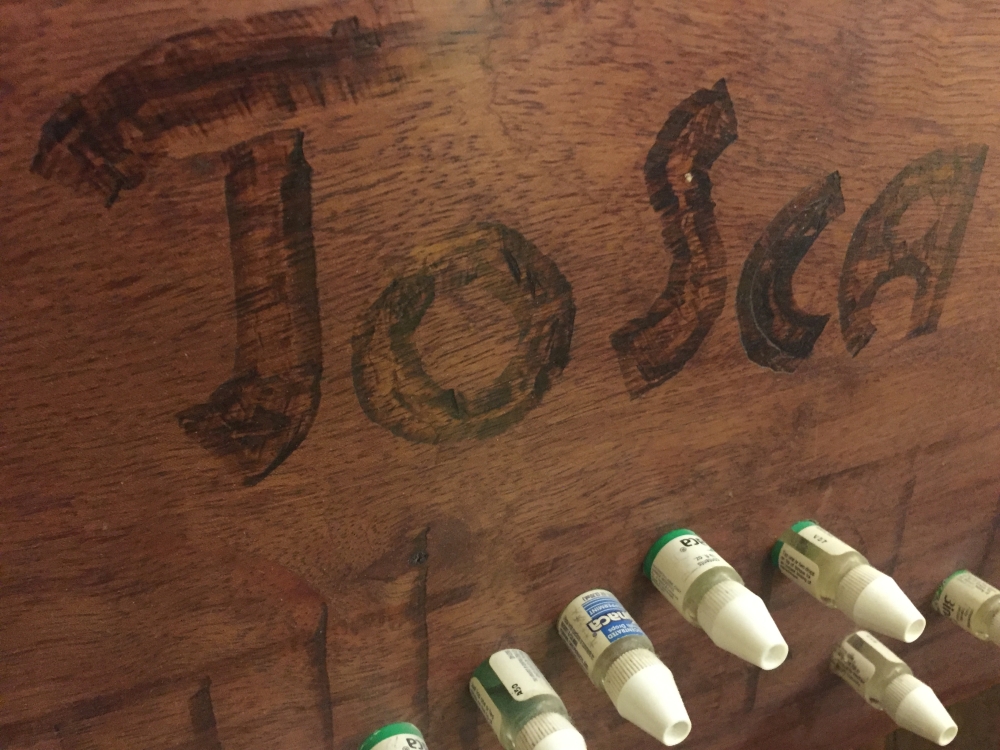
One of my colleagues (I’ll call her Ms. XX) tried to unhinge or discredit me by complaining long and loud about the fact that the Binaca made her sick. She even went to the general manager to complain that she couldn’t sit next to me when I used it. Ardis Krainik told her, “If that’s what makes him play so well, maybe you should try it.” She was then permitted to sit in the back of the section every time there was a cello solo. Among the orchestral colleagues, Binaca became known as “XX repellent.” At my retirement, my colleague Walter Preucil presented me with a very large board consisting of the first part of the Tosca solo with the treble clef and the five lines of the staff, and with Binaca bottles serving as the notes.

The central pieces of my solo repertoire are the Tchaikovsky “Rococo” Variations, the Francoeur E major Sonata, and the Schubert “Arpeggione” Sonata. One of my colleagues, an expert in contemporary music, once waltzed into a rehearsal claiming that the Francoeur Sonata and Rococo Variations were complete garbage. I replied by saying, “That may be, but they are very hard complete garbage.” (and “If Tchaikovsky is complete garbage, what does that make Elliott Carter and Charles Wuorinen?”) Another colleague claimed that nobody can play the “Arpeggione” Sonata in public because it’s too hard, to which I replied, “I play the Arpeggione Sonata great. The New York Times said so.” (New York Times gave me a positive review when I played them at Alice Tully Hall). Jascha Heifetz famously said, “I occasionally play contemporary music for two reasons. The first is to encourage the composers to write no more of it, and the second is to remind myself how much I appreciate Beethoven.”

The opera of choice for the opening night of the fiftieth season of the Lyric Opera of Chicago was Mozart’s Don Giovanni, and it was conducted by Christoph Eschenbach. Don Giovanni has a long and prominent cello solo in the first act, and at the end of the act Eschenbach took my hand and said, “Bravo! No one in the world could play this solo better.” A colleague commented, “You played that solo very well. In fact, that’s the best in tune I ever heard you play.” I replied, “Sometimes you just get lucky.”

A cellist in my section came to rehearsal with a review of a performance she gave of the Schubert B-flat Trio. This reviewer panned the violinist but described the “excruciatingly difficult cello part” as being played “in an exemplary manner.” I was annoyed that the violinist was being exposed so negatively to colleagues who knew him. I made sure to mention that I played the Schubert B-Flat Trio in Carnegie Recital Hall three times, and in the New York Times reviews nobody ever mentioned that the cello part was excruciatingly difficult when I played it.

According to the rules and regulations that governed auditions at the Lyric Opera, the principal of the affected section was asked to choose the repertoire. This was known as the “list.” The principal player was required to consult with the music director, but the list was still the domain of the principal.  During a lunch hour between rehearsals the music director  called me in to his office to discuss the list that we had to make for an upcoming audition in the cello section. When we came to the very important, prominent, and difficult cello solo in Die Frau Ohne Schatten by Richard Strauss, this music director asked me if I thought I was still capable of playing the solo. I told him that  the last time I played it, Maestro Janowski told our general director Ardis Krainik that I played this solo better than anybody in the world. I added that I could play him the recording of the opening night broadast to prove it. He responded by asking me if  I was just bullshitting him to get him off my back when I declared I was planning to retire after the 2005 season. To this I replied, “Absolutely.”

I broke a long silence by saying, “It looks like you’re stuck with me.” He replied, “I can do something about that,” and I told him that we would have to because I wasn’t leaving. This music director sent me a letter listing all the things he thought were wrong with my playing (this was required by the contract). It didn’t bother me as much as it could have because three months later a review of a trio concert I played in Carnegie Recital Hall (we played trios by Shostakovich, Brahms, and Mendelssohn) appeared in The Strad  calling me a “superb cellist whose vibrato, tone, and phrasing were always exemplary.”

We played Frau in the next season, and I nailed the solo twelve times in a row (two dress rehearsals and ten performances). The music director called me to his office to tell me that he was rescinding my letter, and told me that I could stay as long as I like. I told him (in a voice that felt like it was dripping with sarcasm) that I was highly complimented and that I would do my very best to justify his faith in me.

I always had the suspician that a sycophantic colleague set up this situation, but ultimately that music director did me a big favor. Because he challenged my ability, I was motivated to play as well or better in my late 60s than I did in my early 40s.

Very early in my career I understood that in situations where other people had authority over me, and where my income and reputation were involved that if they can screw me, they will. They wouldn’t necessarily screw me right away, but eventually it would happen. I knew that there were two ways of not getting screwed: I could get them to not want to screw me, or I could legally prevent them from screwing me.

A rumor will travel halfway around the world before the truth gets its pants on, so in 1975 when the contractor and the concertmaster of the American Ballet Theatre orchestra started asking me what happened to my sound, I understood that it must have been the result of a rumor.  In 1975 and 1976 my sound was reviewed in the New York Times as being “robust and energetic,” which kept the rumor that somehow my sound was not what it used to be at bay, but when I noticed that I had not gotten my contract for the winter season at the City Center, I called the conductor and the contractor. They both told me that they thought I was going to be in Chicago. I told them that they never heard that from me, and that if I didn’t have a contract in 48 hours, I would assume I’ve been fired and will act accordingly. I was favorably viewed by Lucia Chase, the director of the company, so this was not an idle threat. Lucia Chase had attended both of my Alice Tully Hall recitals and knew that I was the principal cellist of both the Lyric Opera of Chicago and the American Ballet Theatre. I got my contract.

After this experience I could see the writing on the wall, so I spoke to Jim Stubbs, the principal trumpet, and Porter Poindexter, the principal trombone, about organizing the orchestra. The three of us went to Max Arons, president of Local 802 of the American Federation of Musicians, and we asked him if we were to organize the orchestra, would he recognize us as the bargaining unit. He told us that he had been waiting for this for years, and gave us his blessing.  We held a meeting on the last day of the season and got a strike vote on the issue of instantaneous tenure for everyone there. That meant that no other musicians could play for the American Ballet Theatre in New York City.

Pleased with our audacity, we decided, since we were moving into the Metropolitan Opera House and would have a larger orchestra, we should insist on having instantaneous tenure for the eleven additional players who were not currently playing at City Center but who had long histories with ABT. The company naturally baulked at our proposal, but when we told them that we had a strike vote and intended to use it, they gave in and we got what we wanted. And, of course, none of us could be fired.

The American Ballet Theatre contract stated that a player had to be notified at the end of a two-year probationary period if they were not getting tenure. In other words, if nothing was said after two years, the player would automatically become a tenured player of the orchestra. As chairman of the orchestra committee I learned that the concertmaster, a dealer in instruments and bows, wanted to deny tenure to two extremely good players. He clearly wanted to give spaces in the orchestra to some of his clients. I told the conductor that if these two people did not receive tenure, there was going to be a lot of trouble at the contract negotiations the next year and it would all be his fault. Those players were not notified, and they got their tenure. I got a call from this concertmaster telling me that what I did was completely illegal, and he was going to take me up on charges at the union. I said, “You tell Max Arons that you wanted to fire two people, and that I saved their jobs, and see how far you get.”

One of my favorite tricks of invalidators happened numerous times when one or another colleague would say, “are you aware that colleague X isn’t using your bowings?” My standard reply was always, “don’t be a policeman, leave law enforcement to the proper authorities.”

The very worst case of abuse that I was forced to witness happened when Marek Janowski came to conduct Lohengrin. At one point he spent a half an hour dressing down our English Horn player, insulting her nonstop for being completely unprofessional and how could she dare to show her face at a serious rehearsal playing like that. As he was going on, I decided that if he tried that with me I had a very simple response, “Maestro, this is the best I can do, but it’s not the worst I can do.”

Validators and Friends

My Juilliard graduation recital included the Frescobaldi Toccata, the Bach G minor Gamba Sonata, the Brahms F major, the Hindemith Unaccompanied Sonata, and the Boccherini Concerto (with a string quartet accompaniment), but I graduated under a cloud. My teacher, Claus Adam, gave me a C+ as my final grade, and every comment on my graduation exam was negative. I also got a letter from the dean saying that they were revoking my scholarship, but, using the most patronizing language, he said the school would allow me to attempt a Master’s Degree, although the faculty had doubts. I demanded to know why I got a C+ from Claus Adam, and he told me, “If Itzhak Perlman gets an A, you get a C+.” According to that logic, if I got a C+, Claus Adam would get an F-.

The only reason for me to go back to Juilliard for a Master’s Degree, particularly under those ignominious conditions, was that I was prime material for the draft board, and the war in Vietnam was looming. Fortunately, the draft board rejected me, and I did not have to go back to Juilliard.

Marianne Kneisel engaged me and another professional cellist for her summer festival and school in Blue Hill, Maine. Kneisel Hall had a very distinguished faculty, which included Joseph and Lillian Fuchs, Sascha Jacobson, Edgar Ortenberg, Paul Olefsky, and Artur Balsam. Shortly after the festival began, Joseph Fuchs came up to me and told me “you’re doing great. This summer is going to be the making of you.”

I asked him if he thought I had learned to play the cello in the last four weeks, and told him that there were ten negative comments from the faculty on my Juilliard graduation recital, and that his was one of them. His response was, “Kid, don’t go back to Juilliard. They don’t like you there. Go out into the world. Get a job. Make money. You’ll do well.” I certainly appreciated his candor. He was a great artist and a great violinist, and I learned a great deal from him that summer.

Success is the best revenge. I graduated from Juilliard in 1963, and by 1971 I was getting rave reviews in the New York Times. I have reprinted those reviews often, but I have not reprinted (and will not ever) those comments from my graduation recital.

I made a lasting friendship with Paul Olefsky that summer in Blue Hill. My main reason for going to Blue Hill was to study with him. Paul was a distinguished soloist who had been principal cellist of the Philadelphia Orchestra and the Detroit Symphony. Paul played two recitals at Carnegie Recital Hall in 1963. One was unaccompanied: he played the Kodaly Sonata and the Bach Sixth Suite; and the other had the Beethoven A Major and the Brahms F Major Sonatas.

Paul encouraged me a great deal, and praised my talent and ability. On the last concert of the summer, he said very publicly, “We all try to do what Danny did today.” When we returned to New York, Paul gave me long lessons on the repertoire, charging me $10 a lesson. He told me a story about how he taught a very disadvantaged kid in Detroit for $5 a lesson. At the end of that year, the student’s mother thanked Paul and said, “You did a wonderful job, but now we need to find a new teacher.” When Paul asked why, she said, “If he did so well with a $5 teacher, imagine what he could do with a $10 teacher!”

Paul was very good friends with Emile Siminel, the contractor for the Mantovani Orchestra. It was through that connection that I got my first job: a nine-week bus tour that paid $173 and change a week (gross). I considered this a step up from Juilliard and it was through connections in the Mantovani Orchestra that I got my job as first chair cellist of the American Ballet Theatre Orchestra.

Paul remained a friend and mentor to me until his death in 2013, and his advice was invaluable in the trajectory of my career. He brought all his students from Hartt College to my Alice Tully Hall debut recital, and complained that even the very good review in the New York Times did not do me justice. He joined the faculty of the University of Texas in Austin, and invited me to give master classes.

Robert Gardner, the principal cellist of the New York City Opera and the Aspen Festival orchestra, was one of the great cello talents of all time. He was an important mentor to me, and I admired him tremendously. During a time when I didn’t believe in myself, it was his encouragement that kept me going when I might otherwise have faulted. On Bob’s recommendation I was invited to audition for the principal chair of the Saint Louis Symphony in 1967. I did not get the job, but in preparing for that audition I found my voice. Immediately after the Saint Louis audition, I won an audition for the principal chair of the American National Opera Company, which led to becoming the principal cellist of the Lyric Opera orchestra. When I went off to Chicago, Bob rode in the cab with me to LaGuardia Airport. His parting words to me there were, “As principal cellist of an opera orchestra, you will either be bored to death or scared to death.”

Every Sunday during that first season at the Lyric Opera, Bob would accept my collect calls, advise me, and sympathize with me. Throughout the years, he’s been my dearest friend and supported my career and my life, and I consider his friendship one of the greatest blessings in my life.

Since I grew up in the era of reel-to-reel tape, I have had to transfer many old recordings to CD in order to hear them. I was surprised to find recordings of the violinist Gerald Beal playing the Vitali Chaconne and the Bach Air on the G String on a tape from 1971. I had forgotten the extent of his extraordinary artistry. Jerry had tremendous influence on the development of my playing. He was an amazing character, who lived in a strange world, defined on one side by genius, and fantasy on the other. It is impossible for me or anyone else to separate fact from fiction about who Jerry actually is, but I feel compelled to write about him. And these events from 40 years ago are true.

Jerry was the assistant concertmaster on a long tour of the Royal Ballet, featuring Margot Fonteyn and Rudolph Nureyev. Jerry had been a famous child prodigy who toured the world with his identical twin brother, Wilfred, playing the Bach Double Concerto and various other two-violin works. He had a notorious tendency to make things up, so I had mostly avoided him. But one day, between matinee and an evening performance at the Metropolitan Opera House, I heard him play an extraordinary performance of the Fugue in C Major by Bach. There were two things about Jerry that I knew were absolute fact: he was a long-time student of Galamian, had studied with Heifetz at a time before Heifetz gave master classes.

My wife, June, who was also on the tour, had asked Jerry to give her a lesson on how to practice scales. I was intrigued, and so I audited the lesson. I asked Jerry to show me a few things as well, and it took him less than 45 minutes to elevate the level of my playing beyond anything that I had ever been able to do. I worked with Jerry seriously over the next five years, experiencing his generosity of spirit and his unique musical genius. He helped me prepare my first five New York recitals (March 1970 through May 1972).

During the Royal Ballet tour in 1967, I was extremely tight and desensitized to the instrument. I found it impossible to express myself musically. One night in a hotel room in Seattle, Jerry showed me a series of exercises to learn to use the least possible amount of pressure in either hand to get a sound. I objected vehemently to the whole concept that less is more. Jerry, however, patiently worked with me, saying over and over again, “Just try it!”, to which I said over and over again, “You must be out of your mind!”  After an hour and a half of this back-and-forth, which no reasonable teacher would put up with for two minutes, I got it. I was then able to actually initiate a note, develop the sound, and end the note any way I wanted to. Jerry made sure that I knew that every note has a beginning, which is an attack, a middle, which is a development, and an end, which is either a tapering off or a connection to another note. Jerry opened my consciousness to the connection of silence to sound, the infinite variety of expression the sound, once created, could achieve, and the joining of sound back to silence, or continuing to join one note to another. In those ninety minutes, Jerry managed to get me to organize my playing into terms of attack and release.

I had problems with the release part, but once I got it I had a degree of control that I never even imagined was possible. I owe my success with auditions to what I learned that day from Jerry Beal.

In 1968 there were a mere three weeks between the American Ballet Theatre’s Metropolitan Opera season and the first rehearsal of the Lyric Opera in September, and my first opera was Richard Strauss’s Salome. Jerry insisted that I work through the entire cello part plus several important solos in the “B” cello part with him. During those lessons, where we explored the possibilities technically and musically of every single note, I came to know large sections of the opera by memory.

Jerry’s extraordinary imagination managed to make a line of notes technically secure and musically compelling. I still don’t understand how he did it, but it took him 24 hours of intensive work spread over three days to accomplish this with me. It boggles the mind to imagine the generosity of soul a teacher could have to volunteer this level of commitment. Jerry definitely understood that making a stunning impression would have the longest-range positive implications for my career. The result of all my work with Jerry on Salome was that I was completely lionized by Bruno Bartoletti, the music director, and Carol Fox, the general director. I have an ineffaceable memory of my first performance on that opening night. I played the cello part like a concerto, and led both the cello and bass sections with a level of power that I have rarely experienced since.

In January of 1969 I returned to New York from my first season with the Lyric Opera, and was offered a job as the cellist in the Reston Trio, which performed as part of a summer program in Reston, Virginia. I was faced with the daunting task of playing six chamber music concerts and the Dvorak Concerto with the orchestra. Jerry saw the long-range implications of me succeeding above and beyond my or anybody else’s expectations, so lesson after lesson, and hour after hour, he taught me to pull every single bit of beauty out of the Dvorak Concerto, and all the solos in the Schubert B-flat Trio, Mendelssohn D minor Trio, the Mozart Divertimento, and the rest of the trios that I would be playing that summer. As the summer approached I became so nervous that I broke out in boils. I was ready to resign until Jerry assured me that my reaction was a perfectly natural reaction to something that challenged me beyond what I had previously ever done. To this end, Jerry gave me extra lessons, just to make sure that I knew that I could do everything that was required of me.

Jerry probably knew that he had an unsavory reputation, and that may have been the reason he encouraged me never to mention him in print as one of my teachers. He assured me that the name of Leonard Rose would carry a great deal more weight, and would cast me in a more positive light. He absolutely maintained this position through the five years that I worked with him. There was nothing in this extraordinary act of generosity for Jerry in terms of furthering his career.

Elliot Magaziner, the violinist of the Reston Trio, booked Carnegie Recital Hall for two trio concerts scheduled for March and May of 1970. I had not played any major concerts in New York, and I had read many extremely damaging and unfair reviews of colleagues in the New York Times. I was so worried that I would join their number that I went into a tailspin that could be described as a nervous breakdown. When I was in this state of psychological vulnerability, Jerry showed his very best qualities as a caring and compassionate human being. He told me again and again that many artists go through these kinds of lapses of confidence, and that by coming through could create a sort of bank account of psychic strength, which I could tap into in the future. He listened to me play by the hour, constantly encouraging me, but a week before my first concert he simply disappeared.

I made up my mind to show up and play those concerts, regardless of the consequences. Jerry reappeared the day before my first concert to check me out, and he told me that he knew it was me who had to make the decision to play.

The concerts went well enough, and my emotional state fortunately switched from depression to mania. I decided it was time for me to make my New York debut. When I told Jerry about my plan, he insisted that Carnegie Recital Hall was no place for a major debut. He said that the only place to do it would be the newly opened Alice Tully Hall at Lincoln Center. The thought of that both took my breath away and shook my confidence. I told Jerry that I would be willing to do it under the condition that he work with me as much as necessary for six weeks before the recital. He agreed, and he did.

I first worked with the great violinist Aaron Rosand in 1965 when he played the Bruch G minor Concerto with the American Ballet Theatre orchestra. At 37, Aaron was very handsome, and he played the violin like a god. Hearing him from barely ten feet away was a revelation. Three years later, he returned to the American Ballet Theatre to play the violin solos in Swan Lake. One of those solos included a big cello solo, so I had the opportunity to play one-on-one with him. Aaron said he liked my playing a lot, and he recommended me to play the Dvorak cello concerto on the same series that he was playing the Brahms Violin Concerto.

Aaron Rosand made a lot of money playing commercial music in New York, and he used the money to travel to Europe and record concertos with orchestras there, and those recordings are still being reissued. He also played stupendous programs of virtuoso violin music in Carnegie Hall. His example that enabled me to follow Danny Newman’s advice, and take my destiny into my own hands whenever possible. I was perfectly willing to finance my own recitals and recordings.

He gave me great advice. He said to practice in front of a mirror a certain amount every day to make sure that my form was good, and he advised me to record much of my practicing but only listen to five minutes of it every day. He told me about the time he snuck into Carnegie Hall three hours before a Heifetz recital. He observed Heifetz walk on stage and practice a small phrase over and over until he was satisfied. Then Heifetz walked off the stage. When he walked back on to play his recital, every phrase sounded like the one he had practiced.

Rosand told me that you need to be 200% prepared in order to play at 100% on stage. That was great advice for me, because my nerves often reduced my capacity to well under 100% of what I could do under the best circumstances. I was so nervous in the opening piece of my Alice Tully debut recital, the Francoeur E-major Sonata, that I wondered in the last movement, a very fast allegro, whether I could be that nervous and still play. Fortunately for me all 50% of what I would normally do was enough to get me through, so that there was no noticeable lapse.

Once again I wondered how one could be this nervous and still play on opening night of Schoenberg’s Pierrot Lunaire at the Metropolitan Opera House with Rudolph Nureyev dancing the title role (which absolutely guaranteed a full house). Luckily, I had taken Aaron Rosand’s very good advice and practiced the part assiduously for a month before that performance. Interestingly, I was not nervous at all for any of the subsequent performances.

Aaron spent all his money promoting himself as a violin soloist, and he compromised himself financially in order to afford the “Kochanski” del Gesù, one of the world’s greatest violins. At the end of his performing career, he sold the instrument for $10 million, became the head of the violin department at the Curtis Institute, and told me on his 90th birthday that he could still outplay all of his students. I am happy that I was able to repay Aaron Rosand’s kindness to me when I recommended him to the International Music Company as their principal violin editor.

Building a Legacy

Without a doubt, the person who will have the greatest impact on my legacy is William Ryden (1939-2018), an excellent composer who served for many years as the editorial director of International Music Company in New York. I first met Bill when I suggested that International publish a compilation of cello solos from the operatic and ballet repertoire. Leonard Rose edited three books of orchestral excerpts for IMC, and they also published Strauss and Wagner excerpt books, but those books didn’t include the very important opera and ballet repertoire. Since I had studied with Leonard Rose, and had been principal cellist of both a major ballet and a major opera company for many decades, Bill embraced the project and published the book in 1999, the year that Puccini’s music entered the public domain. When a review came out two years later in the American Record Guide of our recording of the complete Brahms trios for violin, cello, and piano, Bill asked us to make editions of these trios for IMC. This was most unusual, since IMC already published unedited editions of all three trios.

After the success of the Brahms, Bill mentioned that a trumpet book by Michael Sachs, the principal trumpet player of the Cleveland Orchestra, was selling very well. He asked me if I could write a method book for cello. I was happy to write a method book, and I took the opportunity to write in detail about the way Leonard Rose taught the bow arm. Bill mentioned that in the Sachs book had explanations and practice exercises for the Hummel and Haydn Trumpet Concertos, and he wanted to know if I could do something like similar for the cello. With Bill’s help and encouragement, I made editions of concertos by Boccherini, Haydn, Saint-Saens, Schumann, Dvorak, Lalo, Elgar, and Tchaikovsky. Making these editions gave me the opportunity to ask the following question on every eight bars of every concerto: “if I was having a bad day, and I had to play these eight bars at the Metropolitan Opera House, and sound good doing it, how would I finger and bow these passages?” I was able to publish cello reductions of the orchestral accompaniments so that teachers could accompany their students, and I was able to include exercises to help with specific passages.

I was always stimulated by Bill’s vast knowledge and deep insight into music and musicians when we met for lunch at Keene’s in New York, or at Russian Tea Time in Chicago. During one of these lunches in Chicago, June asked Bill if he had written any music for piano trio. A week later, a manuscript with two string parts arrived at our home. These were the first of twelve rags that the American Chamber performed in Carnegie Hall and recorded shortly afterward. When we inserted a group of three Ryden rags between trios by Mendelssohn, Brahms, Ravel, Beethoven, Dvorak, and Schumann, it was always Bill’s pieces that got the most enthusiastic audience reaction. Bill had a beautiful, unique, and authentic voice and his music often touched me as deeply as Chopin or Beethoven. The day before Bill died, June and I were listening to our recording of the Ravel Sonata for Violin and Cello which we in the process of editing for International Music. At the end of the Ravel came three of Bill’s rags for violin and cello, and we were both struck by how much more we liked Bill’s duos than Ravel’s. His music will always bring a smile to my face or tears to my eyes.